Find A Trail. Start Your Search Here:

Monday, May 8, 2023

Higher Learning-Extra Credit Loop

HIGHER LEARNING-EXTRA CREDIT LOOP

Blowout Wash Trail System is well signed

Situated in the foothills below Mingus Mountain a couple of miles south of the Town of Cottonwood, The Blowout Wash Recreation Area trail system offers an airier alternative to crowded Sedona-area hike destinations. 

Yucca bloom on the Extra Credit Trail

The 15+-mile system in Prescott National Forest is made up of flowing singletrack loops that are easy to customize for both challenging day hikes and easy strolls. 
View of Mingus Mountain from Bullseye Trail

The loops run through a scenic mix of  high desert terrain. 
Barestem larkspur bloom March - May

The varied terrain and microclimates of water-scoured washes, a chiseled stone-walled canyon, edgy ridgelines and high desert grasslands are the backbone and soul of this always entertaining non-motorized maze.  An excellent, moderate-rated introduction to the area links up four trails for a tour of some of the system’s sweet high point vistas. 
Desert Four O'Clock bloom April - September

Beginning at the main trailhead along Forest Road 493, the loop begins with a 0.2-mile walk on Blowout Canyon Trail. 
Trail cut visible on knoll from Higher Learning

Right out of the chute, the hike delivers amazing 360-degree vistas, dominated by 7,818-foot Mingus Mountain in the west and the sprawling Verde Valley to the north. 
Thistle frame a view on Extra Credit Trail

The route then veers right onto the Bullseye Trail where it begins a leisurely mile-long climb through a corrugated landscape dotted with junipers, common hop trees, velvet ash, yucca and cacti.
View of Sedona Red Rocks from Bullseye Trail

At 1.2 miles, the circuit connects with the Higher Learning Trail. 
Bear grass on the Higher Learning Trail

This segment offers the best views of Sedona Red Rocks, the twisting, green channel of Oak Creek and the geometric layout of vineyards in the valley below.
Strawberry hedgehog cactus bloom March - May

But the views are temporarily swallowed up where the trail slides into a minor canyon before swinging back uphill.
Silverleaf nightshade bloom April - November

Higher Learning Trail ascends a ridgeline

The hike encounters a breezy lookout point at the Extra Credit Trail junction-- a treeless ridgeline with a fringe of yucca and prickly pear cactus anchoring an expansive grassland flush with wildflowers like Barestem larkspur, sego lilies, Four O'Clock, antelope horns, tufted evening primrose, silverleaf nightshade, thistle, prickly poppies, Blackfoot daisies, scarlet beeblossom and miniature wool star--to name a few. 
Range ratany shrubs bloom April - October

At the junction, hikers may opt for a longer, 6.7-mile loop by continuing straight ahead, or a 4.9-mile-miler by turning left at the sign. Either way, Higher Leaning reconnects with the Extra Credit Trail that makes an easy, half-mile descent to reconnect with the Blowout Canyon Trail.
Scarlet beeblossom bloom April - September

Along the Blowout Canyon segment, peeks at the steep-walled, eponymous canyon and an impressive community of ocotillo and blooming cactus enter the fray.
A short trail climbs Blowout Butte

Over this half-mile leg, distant mountain peaks hover over the southern horizon while flowering shrubs like range ratany vie for attention underfoot.  Back at the Bullseye Trail junction, the route doubles back to the trailhead where a colorful map kiosk shows the entire trails system layout and more ways to enjoy the quieter side of Verde Valley hiking. 
Blowout Wash trailhead

Wing-like seeds on a common hoptree


LENGTH:

Short Loop: 4.9 miles

Long Loop:  6.7 miles

RATING:

Short Loop: moderate

Long Loop: moderate

ELEVATION:

Short Loop:  3,806 – 4,318 feet (926 feet of accumulated elevation change)

Long Loop: 3,806 - 4,675 feet. (1,129 feet of accumulated elevation change)

GETTING THERE:

From Interstate 17 north of Camp Verde, take the Cornville Road/County Road 30 exit 293. Continue 17.7 miles west on Cornville Road, which will turn into Mingus Avenue and then Forest Road 493, to the Blowout Wash Recreation Area trailhead on the right. For reference, the trailhead is 1.5 miles south of the Cottonwood airport. Roads are paved except for a short section of rough dirt that’s suitable for all vehicles.There are no fees or facilities at the trailhead.

INFO:

Prescott National Forest

https://www.fs.usda.gov/recarea/prescott/recreation/recarea/?recid=84363&actid=50

Tuesday, May 2, 2023

Black Mountain Canyon

BLACK MOUNTAIN CANYON

Parsons Tank on FR 9243B in Prescott NF

It’s just 582 feet downhill from the paved byway of State Route 260 to the rocky course of Black Mountain Canyon but hiking the dirt back road to get to get to it is deceptively more complicated. Located in a hilly section of the Upper Verde River Volcanic Field in Yavapai County 15 miles east of Camp Verde, Forest Road 9243B cuts through dramatic terrain with a backstory of lava flows, ash deposits, water-scoured canyons and countless geological disruptions. 

The rocky course of Black Mountain Canyon

The rough two track heads north from a dirt pull out along SR 260 in Prescott National Forest on a roller coaster style course that challenges hiking legs with over 1,000 feet of elevation change and delights the eyes.
Bill Williams Mountain on far right horizon

Cliff-rose bloom April - September

The sparsely shaded road wastes no time delivering outstanding vistas and a tour of the area’s diverse eco-zones.  The trailhead is bolstered by two volcanic land forms one being Thirteenmile Rock Butte (5,515 feet) a prominent basalt-topped formation that served as a waypoint on the historic 200-mile General Crook Trail built in the 1800s to connect a chain of military forts that ran from Eastern Arizona along the Mogollon Rim to the Prescott area.
Yucca bloom April - July

 
FR 9243B goes between two volcanic buttes

The other geological standout is an unnamed 5,283-foot volcanic pinnacle with a broken east flank that exposes a base of red and black cinders. Forest Road 9243B begins with a run right between the two stony massifs.
Exposed red cinders tumble from a volcanic butte

Open to off-road vehicles, hikers, bikers and equestrians, the road is a scenic destination for any type of travel, although, the many details along its course are best observed on foot.
Velvet ash trees line the road near Black Mtn Canyon

 
Within the first quarter mile, the road hits a high point overlooking the Verde Valley. On clear days, the distant silhouette of Bill Williams Mountain near the City of Williams can be seen standing over green valleys and red rocks on the northwest horizon.  
Rabbit thorn blooms April - June

The route then makes the first of several dips-and-climbs passing by the exposed cider pit before rounding uphill again for another big vista moment before it begins an undulating downhill spiral. 
FR9243B traces the edge of Black Mountain Canyon

At the 0.8-mile point, the route continues straight ahead where an unmarked dirt road (FR9243C) veers to the left.  Vegetation along the first mile is of the typical high desert variety.  Yucca, junipers, rabbit thorn, cliff-rose, scrub oak, skunk bush and cacti dominate the landscape with an understory of primrose, lupines, lilies, wild carrot and other wildflowers coloring the loose cinder-strewn substrate.
Thirteenmile Rock Butte

Following a steep downhill section, the water of Parsons Tank comes into view in a juniper-ringed depression.

Verde Valley view from FR 9243B

The road swings around the tiny pool where the footprints of skunk, bobcats, deer and raccoons signal the importance of this created waterhole to wildlife. Yet another uphill section lands hikers at a gorgeous vista point above the final descent to Black Mountain Canyon.
Delicate American carrot bloom March - May

Verde Valley viewed from Parsons Tank

On the last edgy plunge, vegetation gradually changes from desert to riparian with ash trees and fruit-bearing shrubs entering the mix. 
Pursh plantain bloom February - July

The road meets the canyon bottom at the 2-mile point.  Marked by a tree-lined boulder crossing, the major drainage makes for a good turnaround point. But the hike may be extended on a maze of dirt roads shown on the Prescott National Forest map.
Strawberry hedgehog cactus bloom Mar - May

LENGTH: 4 miles round trip

RATING: moderate

ELEVATION: 4,374 – 4,956 feet (1,077 feet of accumulated elevation change)

GETTING THERE:

From Interstate 17 in Camp Verde, take the State Route 260 exit 287 and continue 15.7 miles east (toward Payson) to Forest Road 9243B on the left just past milepost 234. Pass the gate (close it behind you) and park in the turn outs along the road.

INFO:

https://visitcampverde.com/general-crook-trail/

Monday, April 24, 2023

White Spar Loop Trails

WHITE SPAR LOOP TRAILS

Apple Blossom trail crosses Banning Creek

In the gullies and hills of the Granite Creek watershed northwest of the Goldwater Lakes, a maze of short, interconnected trails offer access to a diverse pocket of Prescott National Forest.  

Banning Creek Trail

Pine forests, riparian corridors, historic relics, and a strangely out-of-place garden of fruit trees contribute to a continual sting of eye candy in the Central Arizona hike hub.
Water pools in Banning Creek

Collectively known as the White Spar Loop Trails, the shaded singletracks may be explored by way of the White Spar Campground located just a couple of miles south of Prescott’s historic Whiskey Row.
Apple blossoms on April 21, 2023.

Well signed and maintained, the loops are a mash up of newer trails and old standards that also link up with the 50-mile, city-circumnavigating Prescott Circle Trail.  While there are dozens of ways to use the White Spar Loops to cobble together a day hike or backpack trek, a short circuit using the Goldwater Lake #396, Banning Creek #81 (the old standards), Apple Blossom #373 and Twist & Shout #372 (new kids on the block) trails is a perfect introduction to the area’s many faces.
Tall pines on Goldwater Lake Trail

From the dirt trailhead parking lot before the campground entrance, the circuit begins with a 1.5-mile walk on Goldwater Lake #396. This leg climbs easily through stands of Ponderosa pine, alligator junipers and oaks passing by the Hidden Valley trail junction.  

Old water pipeline on Banning Creek Trail

The hike hits its highest elevation (5,920 feet) at the one-mile point, where nice views of iconic Thumb Butte and Granite Mountain peek through coniferous tree cover.  The route then begins a gradual, half-mile  descent to the course of Banning Creek. 
White Spar Loops are well-signed & maintained

The Banning Creek trail #81 junction can be a little confusing. Hikers may head left (north) and follow the wide dirt road that traces the creek’s west banks or go right at the “81” sign and slingshot around to get on the east bank trail. Either way, the two options converge less than a half-mile north where the creek crosses the dirt road.
Golden currant blooms along Granite Creek

Adding notes of history to the hike, an old, elevated water pipeline—a relic of  early 20th century water supply technology-- can be seen following the course of the creek. 
Goldwater Lake Trail is part of the Prescott Circle Trail

Vegetation along this watery leg includes classic riparian species like willows, cottonwoods, boxelder, and golden currant shrubs growing in mucky shallows and boulder-bound bends. At the 2.2-mile point, the route heads left onto Apple Blossom trail #373 among magnificent cottonwoods that stand along a trickling creek crossing.  Within a few yards, the trail comes to another junction where it veers right to meet the eponymous apple blossoms. 
Common mullein is a familiar plant along the trails

Several small, spindly fruit trees line the trail, looking sort of lost among towering pines.  In spring, creamy flowers scent the air and attract pollinators.  Beyond the blooming trees, the route continues straight ahead and uphill the somewhat befuddling  #373/#374 junction.  Now back in pine-oak woodlands, the trail passes by a forested subdivision before meeting the Twist & Shout  trail #372 junction for the loop’s final leg.  
Granite Mountain seen from Goldwater Lake Trail

True to its name, the path winds among oak canopies, making hairpin turns around ravines before rejoining Goldwater Lake trail for the return trip to the trailhead.

LENGTH:  3.7 miles

RATING: moderate

ELEVATION: 5,517 – 5,920 feet

GETTING THERE:

From Courthouse Square in historic downtown Prescott, go 2.8 miles south on Montezuma Street (U.S. 89/White Spar Road) and turn left into the White Spar Campground.  Trailhead parking in on the right before entering the campground. No fee or facilities.

INFO:

Prescott National Forest, Bradshaw Ranger District

https://www.fs.usda.gov/recarea/prescott/recreation/recarea/?recid=75171


Tuesday, April 11, 2023

Amerind Trails

NEW TRAILS COMING TO DRAGOON

Newly constructed trails at the Amerind Museum

Right around the turn of the century, I took a break at the Texas Canyon rest stop during a road trip from Willcox to Phoenix, looked out over the gorge below and thought, “Cool rocks. I wonder if there are any hiking trails in there.” 

Granite formations in Texas Canyon

Turns out, that particular slice of Chihuahuan Desert along Interstate 10 an hour east of Tucson where restaurants and roadside services are sparse, was on private property with no way for curious hikers to explore the wonderland of weathered igneous stone.
Trail designer Sirena Rana in Texas Canyon

That’s about to change, though.

Cottonwoods surround a pond on the Amerind Trails

 
This October, a 5.7-mile trail system is set to open in Texas Canyon on the Amerind Museum property in the community of Dragoon.

“Texas Canyon is so amazing,” says Sirena Rana founder of Trails Inspire and designer of the Amerind Trails. “ There’s so much interesting geology and a lot of people have wondered what it looks like inside.  Up until now, there were no public trails.”

Sirena Rana on the trail to whale rock

The stony parcel of Texas Canyon sits in the shadow of the Dragoon Mountains between the towns of Benson and Willcox. Nearby attractions like the Chiricahua National Monument, Cochise Stronghold, Willcox Playa Wildlife Area, Tombstone, Southern Arizona wineries and acres of Coronado National Forest are big draws for tourists and locals alike.

The tafoni rock in Texas Canyon

But Dragoon and the Amerind Museum remain comparatively under the radar.  The Amerind Museum is a sort of hybrid museum, art gallery and research facility dedicated to archeology, Indigenous cultures and Western art that’s been around since 1937.
Whale rock is a highlight of the Amerind Trails

Seeking to extend its reach, enrich visitor experience, and build interest in the area, museum officials contacted Rana after seeing her presentation on how trails can benefit communities to explore adding hiking trails to their property in Texas Canyon.

“When designing trails, the first thing I do is find the people who know about the land. Locals, neighbors, hikers and experts who know what’s special about the terrain,” Rana says.  “To me, the most important thing is to make trails accessible to all. I like a series of stacked loops that allow for a lot of options and are customizable for all levels of difficulty and lengths.”

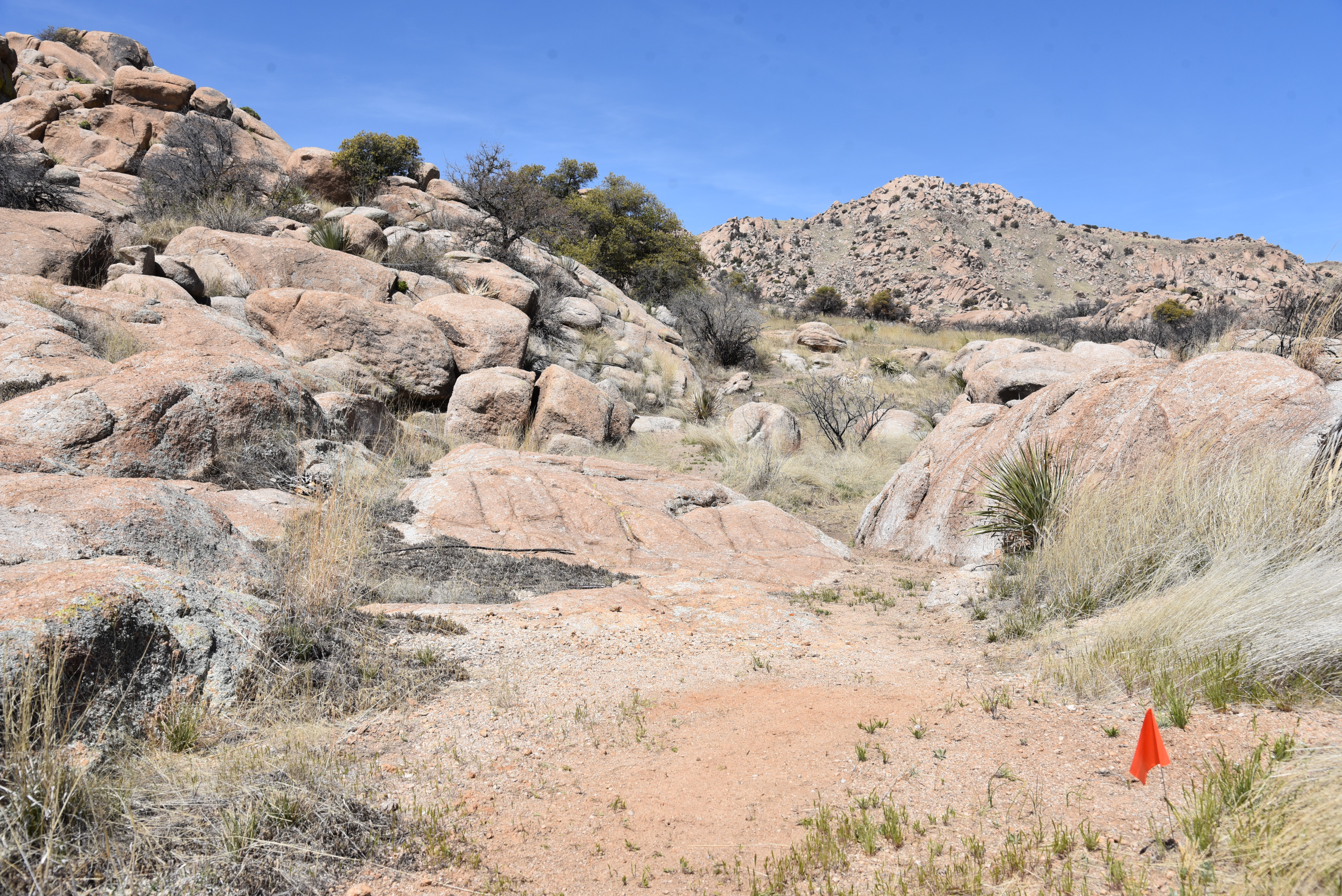
Routing the 5.7 miles of trails through the dramatic, boulder-strewn terrain was tricky, but extensive site scoping and design research paid off.

Windmill with Dragoon Mountains on horizon

The whale trail departs from a picnic area

“We found routes by using the grasslands in between the rocks and natural granite passages while keeping close to interesting control points like cliffs, dramatic rock formations and ponds,” Rana shared. The careful planning has yielded unique pathways into some of the area’s standout geological wonders including a naturally sculpted tafoni rock and the (soon-to-be Instagram darling) whale rock.

Dragoon Mountains seen from Amerind Trails

The stone pillars, balanced rocks, slabs, grottos, spires, and fractured joints within the trail system are the result of millions of years of geological activity and weathering of quartz monzonite (aka granite) that crystalized underground.  As the land surface slowly eroded, the harder granite intrusion was exposed to the elements that would shape them into the bizarre forms seen today.
Golden corydalis color the grasslands Feb - Jun

For trail construction, Rana selected an Arizona company that specializes in building sustainable recreational trails that respect natural landscapes and cultural resources.

“For construction we used Flagline Trails, a Flagstaff-based contractor,” Rana says.  “They are incredibly talented and the crew did an amazing job. They took my design and made it as good as can be. The system has three access points, north and south loops plus an out-and-back trail to whale rock. There will be benches placed along the routes and signage and painted paw prints to mark the trails where they cross bedrock will be installed over the summer. The trails will be open for day use only .  There’s no camping at the site, but there are plenty of places to camp and stay in neighboring towns and in Coronado National Forest.”

Trail construction began on January 3, 2023 and wound up in April. 

Painted paw prints will mark the trail where it crosses bedrock

Using “Amerind Trails” as a working title, official naming of the trails is in the works. “We handed off the naming of trails, and signage placement with our recommendations to the Amerind Foundation,” Rana says. “I’m thrilled with how the trails turned out and they are sure to be a great contribution to the community.”
Interesting geology dominates the landscape

A grand opening event will be scheduled for October and if all goes as planned, the community of Dragoon is going to need a restaurant.

LENGTH: 5.7 miles

RATING: easy-moderate

ELEVATION: 4,643 - 4,873 feet

GETTING THERE:

Amerind Museum

2100 N. Amerind Rd., Dragoon, AZ.

From Interstate 10 south of Tucson, take the Dragoon Road exit 318 and follow the signs 1 mile south to the Amerind entrance on the left.  

HOURS: The museum is open Tuesday – Sunday 10 a.m. – 4 p.m.. Closed on major holidays. Trails will be open for day use only.

There’s no camping on the property, but there are nearby campgrounds and lodging.

FEE: $10 - 12

FACILITIES: picnic tables, restrooms, museum exhibits and events

INFO:

TRAILS WILL OPEN OCTOBER 7, 2023.

Amerind Museum

amerind.org

Trails Inspire LLC

trailsinspire.com

Flagline Trails LLC

flaglinetrails.com