Find A Trail. Start Your Search Here:

Tuesday, September 1, 2020

Antelope Mountain

ANTELOPE MOUNTAIN

View from the saddle of Antelope Mountain near Greer

A drive along State Route 260 in the White Mountains between Pinetop-Lakeside and Springerville is a tour of extremes.
Fish Creek Corral frames a view of Antelope Mountain

The scenic byway begins in dense woodlands replete with lakeside retreats that comes to an abrupt end near the turn off for the town of Greer where the landscape jumps from piney to pastoral. 

Ellis Wiltbank Reservoir sits at the base of Antelope Mtn.

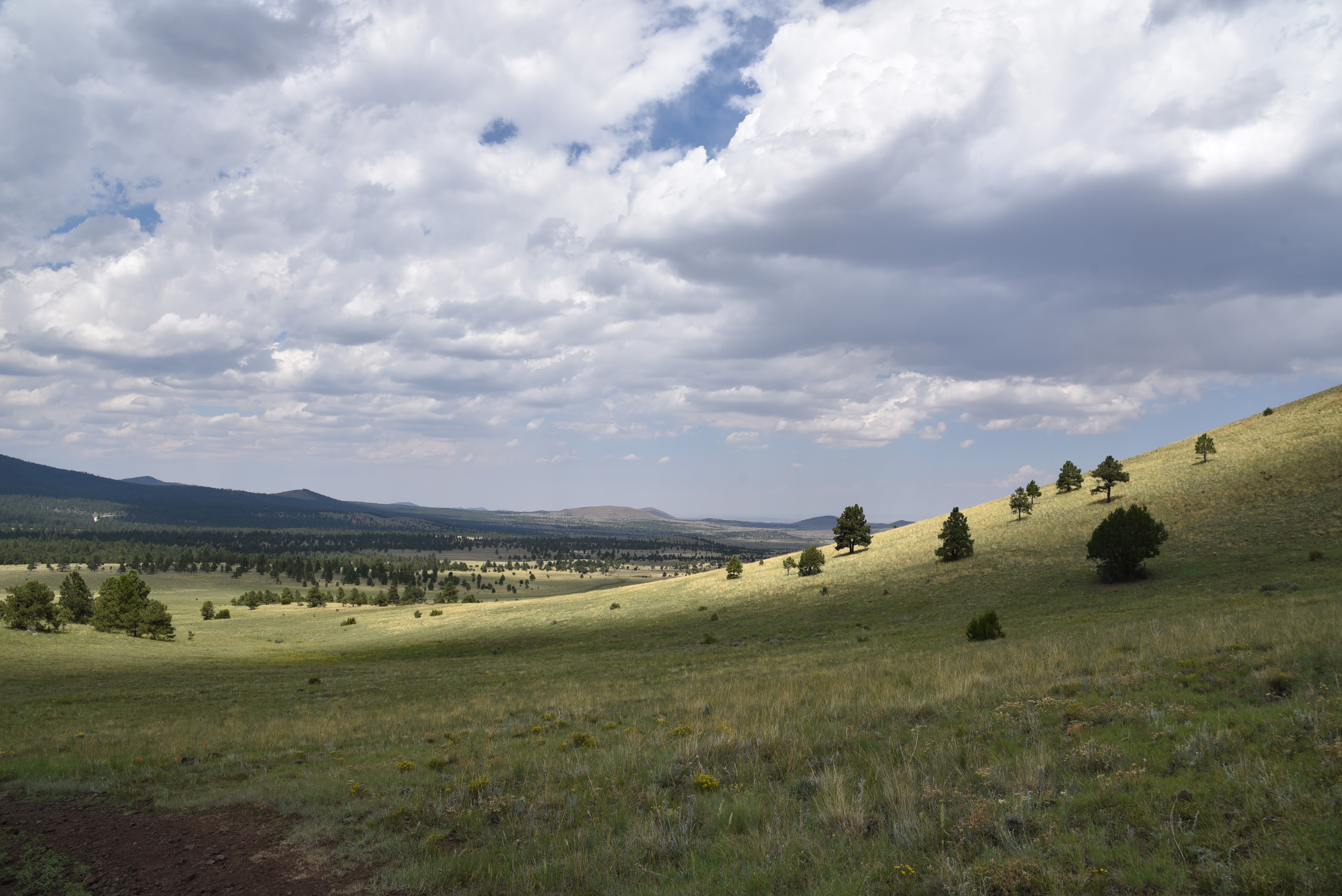
Like a splash of cold water, the terrain suddenly changes into sprawling grasslands and isolated pine-covered knolls. Figuring prominently in the landscape are hundreds of lumps, bumps, slumps and conical hills--welcome to the complex geology of the Springerville Volcanic Field.  This swath of cinder cones and lava flows sits at the southern edge of the Colorado Plateau, a roughly 130,000 square mile collection of some of the country’s most remarkable landforms (think: Zion, Capitol Reef and the Grand Canyon) that covers the four corners region of Utah, Colorado, New Mexico and Arizona.
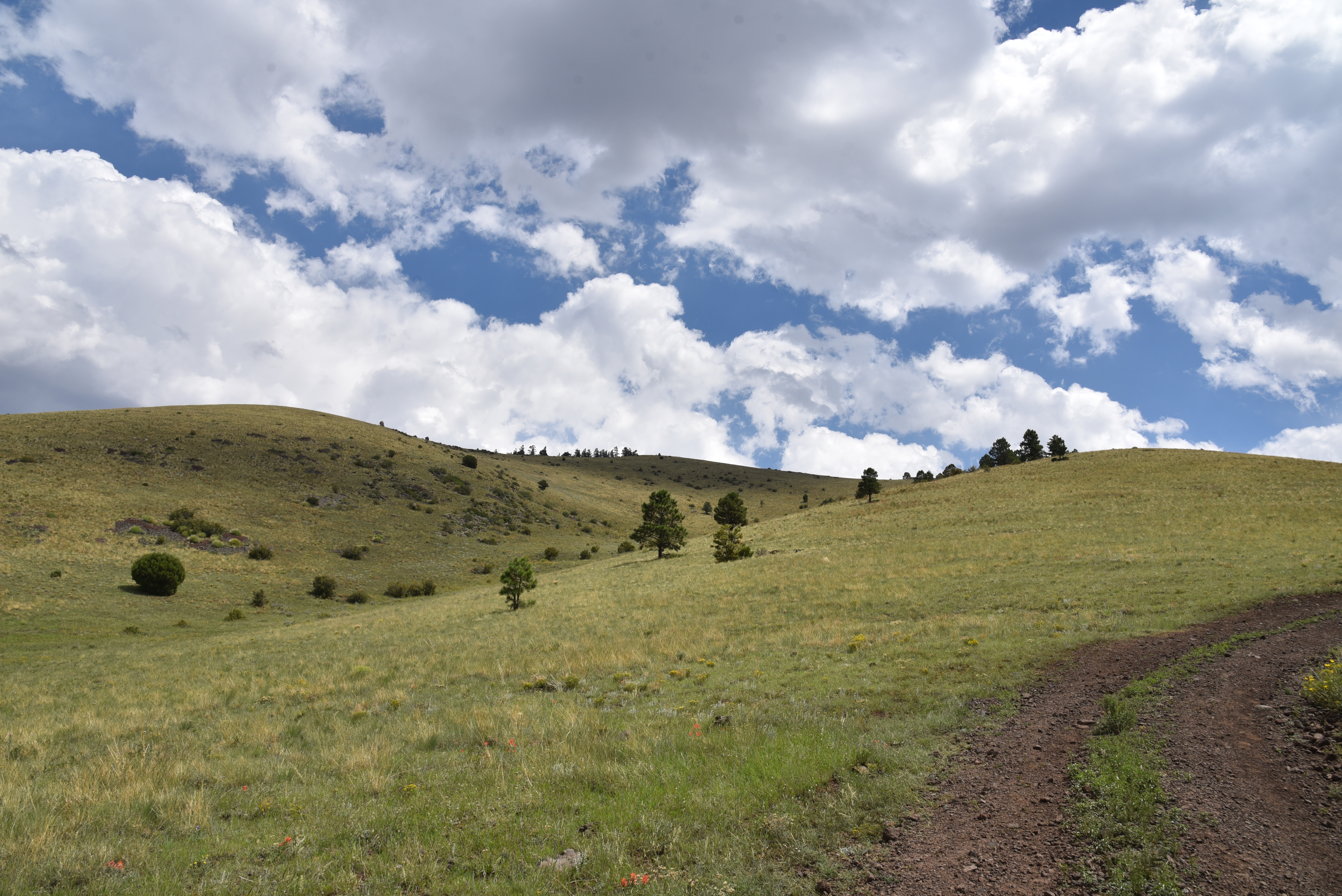
A monsoon storm builds over Antelope Mountain

Springerville Volcanic Field seen from Antelope Mtn.

Sparsely vegetated, the sunny plains sit just north of the course of the Little Colorado River and its tributaries that drain into the Mount Baldy Wilderness area where a mass of lakes, marshes and moist riparian zones stand in stark contrast to the shrubby, windswept volcanic highlands.

Insects feed on a Mountain tail-leaf bush on Antelope Mtn.

Hiking in this bizarre area is both challenging and rewarding.

A textbook-perfect cinder cone seen from Antelope Mtn.

While 10,134-foot Greens Peak, the highest point in the field, is easily accessible on national forest land, many of the other notable volcanic features in the area are located along rough back roads that pass through a patchwork of national forest, state trust, tribal, municipal and private lands, so it’s important that you trek in sync with the laws.

Pollinators alight on New Mexican vervain blooms


One such place to explore is Antelope Mountain, a fascinating cinder cone which is on State Trust Land.  A permit is required to hike the rough dirt road to its 9,003-foot summit. State Trust Land Recreational permits are inexpensive, easy to obtain online and most, including the one for individual hiking access, are good for a full year.  In some cases, such as where Passage 30: Coconino Rim of the Arizona Trail crosses State Trust land north of Flagstaff, a permit is not required as long as you stay within the 15-foot corridor of the trail. That is an exception, though. If you’re recreating on State Trust land, you’ll need a permit.

Antelope Mountain is a cinder cone volcano

Steep approach to the saddle of Antelope Mountain


The deceptively easy-looking road that climbs Antelope Mountain begins at a nondescript turnout off State Route 260 six miles north of the town of Greer.  The first mile is a simple traipse among spotty trees and the wire-and-wood complex of the Fish Creek corrals where the first of two road gates marks the warm up section to the steep climbing ahead. From this segment, the road cut that snakes up the nearly treeless mountain is clearly visible. While it may not look that imposing from a distance, it makes a steady, 30-degree ascent with no breaks. It’s all up, all the way.

A hazy view of Escudilla Mtn on the far right horizon

Road cut visible on the barren south slopes of Antelope Mtn.

Soon, glimpses of Ellis Wiltbank Reservoir, which is on private property, appear in a shallow basin to the left of the road. Look carefully and you might spot domestic cattle, elk and big horn sheep roaming around its mucky perimeter.  At near the 1.5-mile point, pass a second gate that marks the State Trust Land boundary (per state land regulations, leave the gate as you found it, either open or closed) and get ready for the uphill grind.  One hairpin switchback at the 8,500-foot point is all you get in terms of climb-mitigating road engineering.  The rest of the hike makes a straight shot up the mountain’s south flank to the top with the final quarter-mile to the saddle below the summit ridge being the steepest. But great vistas of Escudilla Mountain on the New Mexico border, Mount Baldy, Pole Knoll and White Mountains grasslands take the sting out of the effort. 

Late summer is the best time to see sunflowers in the White Mtns.

Defunct communication equipment on Antelope Mtn.

Looking west from the lone switchback on Antelope Mtn.

On the saddle, the road splits. The left fork goes to the summit proper while the right one leads to scenic overlooks and a heap of defunct equipment, including what appears to be old analogue TV antennas.  A smattering of wind-tortured fir trees standing among outcroppings of basalt boulders and scree line the summit spur. Visible between the trees, a textbook-perfect cinder cone with a symmetrical crater sits 500 feet below the mountain’s north face while dozens of other more lopsided and eroded specimens are scattered on the prairies below.

Forest Road 558 leads to the top of Antelope Mountain

Looking east from the summit of Antelope Mountain

A wild geranium blooms among buckwheat flowers

The road tops out on a bald knob where a huge cairn made of cinders denotes the mountain’s highpoint.  On the top, the tower-clutter summit of Greens Peak can be seen to the west while the diverse mix of forests and open plains of east-central Arizona roll out all around making the quad burning hike well worth the effort.
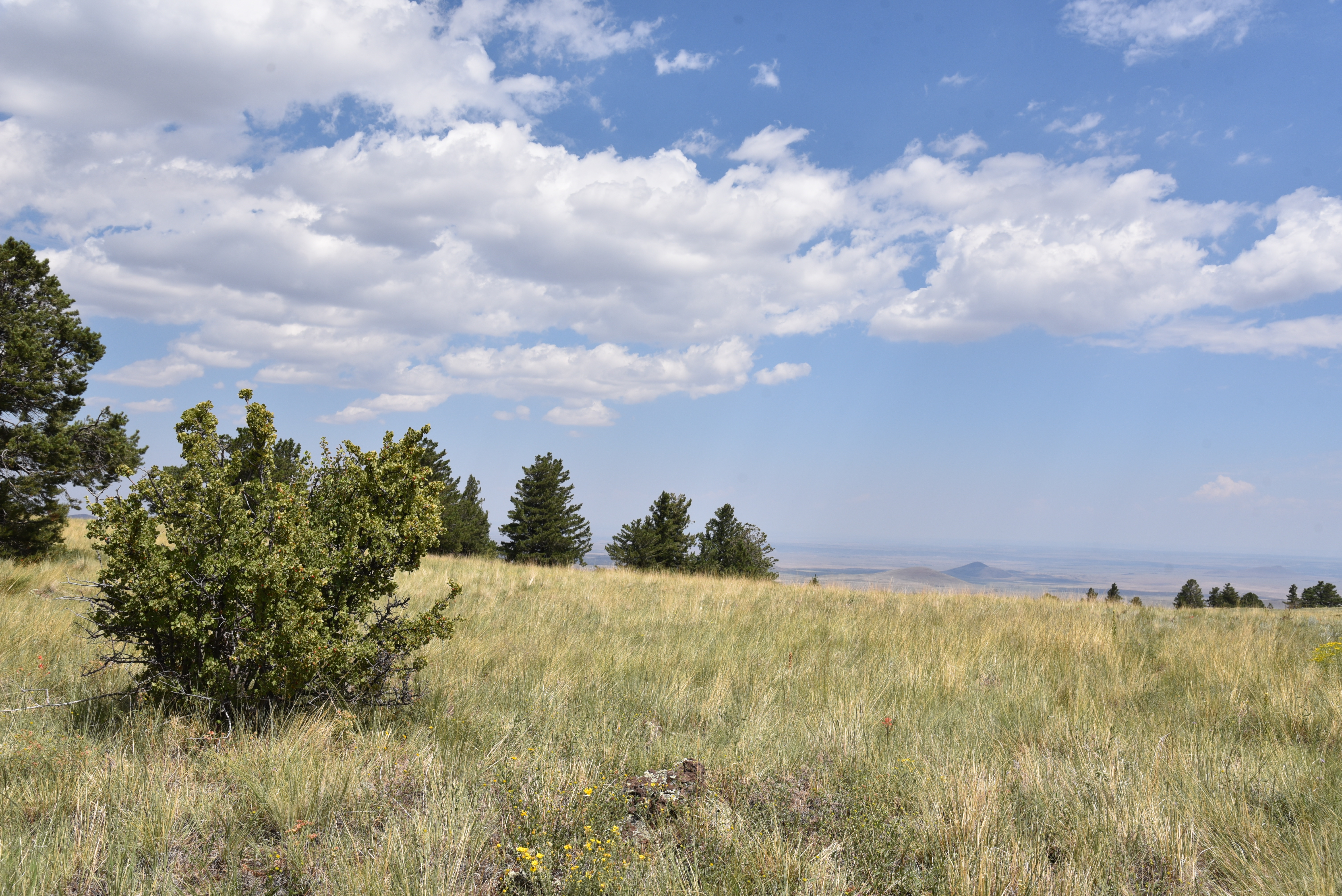
View from the saddle of Antelope Mountain

Greens Peak (far R horizon) seen from Antelope Mtn

A permit is required to hike on Arizona State Trust Land


LENGTH:  6 miles round trip

RATING: moderate

ELEVATION:   8,149 – 9,003 feet

GETTING THERE:

From Show Low go 45 miles east on State Route 260 (White Mountain Blvd.) to Forest Road 558 on the left.  This easy-to-miss road is located 0.7-mile past the State Route 373 turn off for the town of Greer, just past a big Leaving Apache National Forest sign. There’s a parking turnout a few yard in and additional parking farther up the road near a corral. Hike the road to the summit.


AN ARIZONA STATE LAND TRUST RECREATIONAL PERMIT IS REQUIRED FOR THIS HIKE. GET ONE HERE:

https://land.az.gov/applications-permits/recreation


INFO on the Springerville Volcanic Field

http://azgs.arizona.edu/azgs-photo-tags/springerville-volcanic-field

Tuesday, August 18, 2020

A Quirky, Quiet Place in Sedona

A QUIRKY, QUIET PLACE IN SEDONA

Looking west from the trail.

Serene, solitary walks in Arizona’s high desert are good for the soul.  Even in times like these when conditions require us to distance ourselves from others, an occasional escape from the din of civilization can refresh a stressed body and mind. 

The route traces the west flank of Bear Mountain
Revered for its scenic beauty and restorative powers, Sedona is a go-to destination for mental and physical renewal. 
A corral near Robinson and Red tanks
Miles of hiking trails offer escape into gorgeous red rock canyons and cacti-studded mountaintops where the soothing sounds of ravens and digeridoos echo from russet escarpments. When times get tough or just plain confusing, it’s only natural you’d want to make a road trip to Sedona.
Silverleaf nightshade blooms along the route
Yet, once at the gateway to deliverance, you’ll likely discover that everybody else kind of had the same idea.
There's plenty of solitude on this who-knew hike
Miles-long traffic jams, packed trailheads and noisy crowds are the norm in the magnetic northern Arizona town.
 But, if all you want is a head-clearing walk in the desert, there’s a little-used route tucked among some of the area’s most popular hiking trails.  
 Beginning of the non motorized part of the hike  
Manzanita shrubs grow along the route
The satisfying little trek is surprisingly easy to find and mostly ignored in favor of its big-draw neighbors.
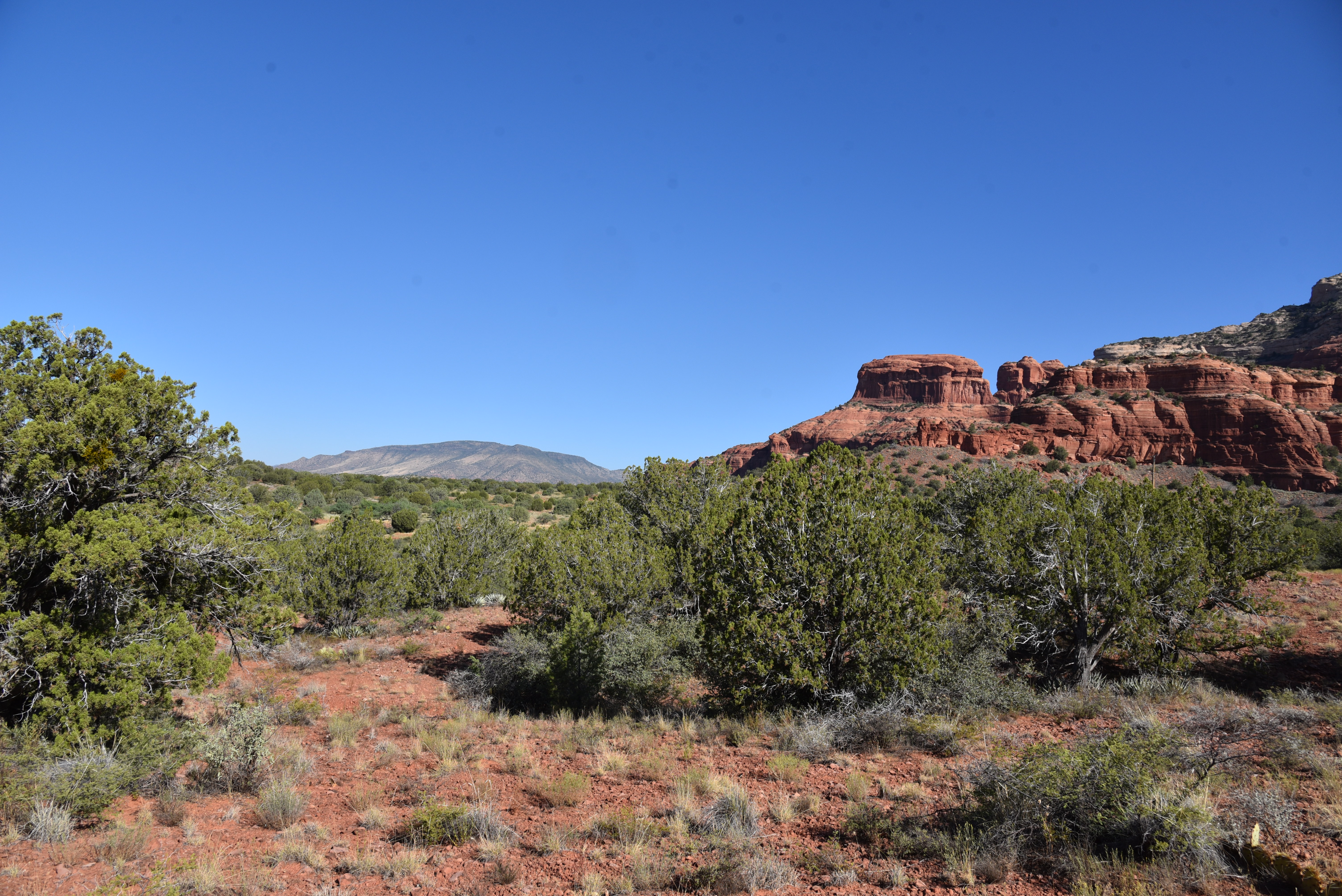
  Located off Boynton Pass Road in northwest Sedona not far from the hyper-popular Bear Mountain, Doe Mountain and Fay Canyon trails, the dusty, deceivingly dull-looking Forest Road 152E provides access to a quiet back country stroll below the western flanks of 6,541-foot Bear Mountain.
The hike follows old roads and rugged paths
From the dirt turnout that serves as the trailhead for this hike, follow FR 152E for 0.3-mile and turn left onto FR 9600.
 
A mesquite tree frames Bear Mountain views
Lightly shaded by junipers and cypress, the route curves through sunny rangeland just outside of Red Rock Secret Mountain Wilderness in Coconino National Forest.  
Looking north toward Loy Butte
After a half-mile of hiking on dirt roads, the route meets a fenced roundabout where a gate at the west end signals the hike’s transition from road to path. To protect wildlife, only non-motorized traffic is allowed beyond the gate.  Off to the left, a conspicuous stand of cottonwoods and a dilapidated corral marks the site of Robinson and Red Tanks, important wildlife water sources.  
The no-name trail welcomes hikers
The unnamed trail, which is part degrading two-track and part scrappy path, passes over and through several drainage areas with wonderful views of 5,700-foot Loy Butte to the north, the famous Cockscomb formation to southeast, the mountains around Jerome and Cottonwood to the west and seldom seen geological layers of the back side of Bear Mountain. Airy and wide open to the sky, this off-the-main-drag gem delivers a healthy dose of refreshing isolation. 
Part of the hike follows FR 9600
The unassuming trailhead
At the 1.3-mile point, the trail narrows and gets more difficult to follow as it ducks into gullies and cacti-tangled manzanita shrubs.
 Unless you’re dressed in protective long pants and sleeves and willing do some searching to pick up the trail beyond the scrubby barriers, make the tree-ringed clearing that sits outside the quagmire the turnaround point for the hike.
Cockscomb (R) and Doe Mtn (L) seen from the trail

LENGTH: 2.7 miles roundtrip

RATING: easy

ELEVATION:  4,487 – 4,564 feet

GETTING THERE:

From the State Route 179/89A traffic circle in uptown Sedona, go 3.2 miles east (toward Cottonwood) on SR 89A to Dry Creek Road. Turn right and continue 4.5 miles to Boynton Pass Road, turn left, go 1.9 miles and park in the dirt turnout at Forest Road 152E on the right. For reference, this is 0.7-mile past the Doe Mountain/Bear Mountain trailhead. There are no fees.


Monday, August 10, 2020

Corner Lake

CORNER LAKE

Gate at the north end of Corner Lake points to Mormon Mtn.
The lone coyote skulked among clumpy grasses and stunted trees barely 30 yards from the degraded two track where I was hiking.  Creeping, crouching, sniffing the air and casting wry glances in my direction, it was clear the stealth beast was on the hunt. Coyotes are Arizona’s most common predator, but they will eat just about anything. Their subsistence staples include juniper berries, mesquite beans, eggs, insects and even garbage and small pets where their territories intersect human populations.  But this day on Anderson Mesa, the coveted item on the menu was pronghorn.
Hike is in the Anderson Mesa Wildlife Protection Area
A tank near Corner Lake sustains wildlife

Located southeast of Flagstaff along Lake Mary Road, the mesa is home to several popular fishing lakes including Ashurst and Kinnikinick in Coconino National Forest.  While the elongated land mass has a few densely-wooded areas, most of the 25-mile-long tableland is a mix of sparse pinyon-juniper woodlands, ephemeral wetlands and expansive grasslands—prime habitat for pronghorn.

Pronghorn (center right) graze on the mesa

The Arizona Trail passage 30, part of which wanders through the northern end of the mesa near Marshall Lake and popular recreation sites northeast of Upper and Lower Lake Mary, provides an excellent introduction to the breezy environs.

But if your objective is wildlife viewing, seek out the maze of back roads that lead to isolated watering holes.  One productive location is Corner Lake. To get there, begin hiking on Forest Road 9483G where a sign indicates entry into Anderson Mesa Wildlife Protection Area.  Within a short walk, the pine-shaded, sometimes dry depression of Corral Tank sits off to the left.  It’s a great place to spot pinyon jays and squirrels that feed on the berry-producing shrubs that grow around the water hole’s perimeter.

At just under a mile, pass through a rustic gate (as with all gates on this hike, close it behind you) and continue a few yards to the Forest Road 9116S junction where the route veers right. Here, what scant shade had been present on the first leg of the hike dissolves into treeless prairies punctuated with isolated junipers with mountain peaks bookending the horizons. About a half-mile ahead, a group of pronghorns grazed lazily on rabbit brush on the wide-open mesa. With nowhere to hide, Wile E. Coyote—who had apparently been following me at a distance—shot me a parting look of contempt before bolting off, abandoning his intended prey. Somewhere, an anvil dropped.

Corner Lake is often dry

Even from a distance, pronghorns are easy to identify by their white rumps and distinctive spiked horns. Outfitted with enormous, wide-set eyes a la Baby Yoda, their vision has

scoping power roughly equivalent to eight-power binoculars. It’s not easy to sneak up on them. As I slowly walked the road hoping for a perfect photo opp, the group of four had me on their super-vision and soon made a charge for a ridgeline. Watching the elegant creatures run was worth the trip. Light-boned and built for agility, pronghorns can reach sustained speeds of 40 miles per hour. Their sprints are more like 60 miles per hour.

The hike around the lake follows a fence line
Pine Mountain (center horizon) over Corner Lake

Following the route to and around Corner Lake is simple, as long as you pay attention to the ground. Deep fissures and chunks of volcanic rock make for mildly challenging footing. 

Approaching Corner Lake
The road meets the lake at the 1.75-mile point.  Like most of the “lakes” on Anderson Mesa, this one’s capacity depends on snow melt and rainfall, two things that are so far lacking in 2020.
Signs at the south end of Corner Lake
The site is augmented with two created wildlife water tanks that, judging from footprints in the muddy fringes, serve dozens of species besides pronghorns. The lake/wetland is enclosed by a post-and-wire fence to protect the sensitive environment. 
The stark beauty of Anderson Mesa
FR 9116S leads to Corner Lake
Although it’s advisable to stay out of the protected area, it is possible to hike around the perimeter fence without disturbing the marshy interior. There are two options for making the 2.2-mile circumference hike. The first is to hike along the outside of the fence where you’ll need to duck under the wire at the two north corners. I am 5’3” tall and small so after removing my pack I was able to crab walk through without harming the fence.
Rabbit brush is a favorite pronghorn food.
Those who prefer to stay upright will want to use the gates located on the west, north and east sides and hike the fence line from the inside. Either way, minimize your impact by sticking close to the enclosure border and never cutting or altering the fence or gates.  Initially, the stark, sun-washed terrain surrounding the lake feels harsh to hikers accustomed to Northern Arizona’s green aspen-and-pine mountain climes. Yet, the utter exposure and what a friend described as “nothingness” embodies what many hikers say they seek—solitude in the middle of nowhere.
Look for birds and squirrels at Corral Tank
Wildlife depend on stock tanks in dry years

Rocky, weedy and windy, the walk around the lake unpacks a panorama of views. Mormon Mountain, O’Leary Peak, Pine Mountain and the San Francisco Peaks stand out over acres of golden grasses while the shallow gorge of Anderson Draw makes an abrupt riffle at the lake’s north end. With its who-knew character and unexpected appeal, Corner Lake is an odd, yet intriguing trip. Not quite desert, not quite forest and not quite a lake, it’s perhaps Arizona’s most beautiful adaptation of nothingness.

San Francisco Peaks seen from FR 9483G

LENGTH: 5.7 miles roundtrip

RATING: moderate

ELEVATION:  7,113 – 7,248 feet

GETTING THERE:

From Flagstaff, go 24.2 miles south on Lake Mary Road to Forest Road 125 signed for Kinnikinick Lake past milepost 320. Turn left and continue 4.7 miles to a junction where the road to Kinnikinick Lake veers right. Park in the turnout on the left where there’s a sign for  Forest Road 9483G and the Anderson Mesa Wildlife Protection Area. Forest roads are maintained dirt that are slightly bumpy but suitable for most vehicles. 

WILDLIFE VIEWING TIPS:

https://www.azgfd.com/wildlife/viewing/viewing-tips/


Monday, August 3, 2020

Buck Mountain

BUCK MOUNTAIN 
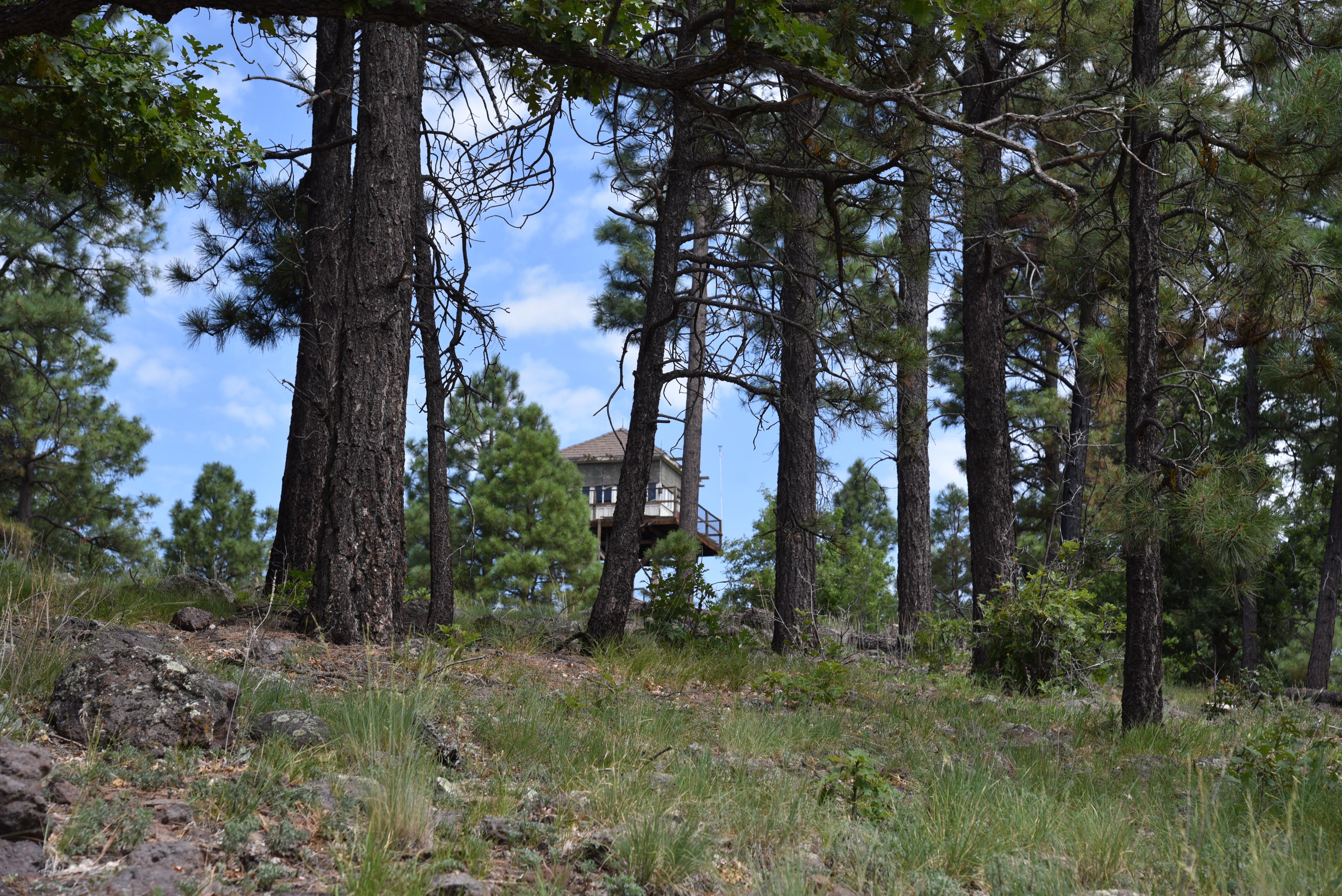
Buck Mountain fire tower
Remember 1973? The year was rife with high-tension world events, political controversy and noteworthy bright spots. There was the Watergate scandal and the resignation of President Richard M. Nixon, the opening of the World Trade Center and U.S. involvement in Vietnam was winding down with the Paris Peace Accords.
View from the summit of Buck Mountain.
On the home front, tennis great Billie Jean King beat Bobby Riggs in a match hyped as “the battle of the sexes” while the Supreme Court decision in Roe v. Wade spurred debate over women’s reproductive rights that’s still roiling today. But all this was overshadowed by two events that got personal.
The hike's last mile is open to foot travel only
First, the Organization of the Petroleum Exporting Countries (OPEC) oil embargo caused angry confrontations at the gas pump, price gouging and fuel shortages. Next, in an ominous precursor to 2020, there was a run on toilet paper. Ostensibly, Led Zeppelin’s North American Tour moored an otherwise utterly confusing year. Turns out 1973 was a reminder that just when things seem to be going great, disruption comes to bite us on the posterior with historic regularity. Decades before the Great Toilet Paper Crisis of 2020 wreaked havoc at the onset of the new coronavirus lock down, other world events lead to shortages of an array of crucial (albeit less personally distressing) materials. Perhaps your great-grandparents shared stories about deprivations brought on by the Great Depression or World War II rationing and how patriotic citizens organized collection drives for tires, scrap metal and even rags and paper to help in the war effort.
The hike follows Forest Road 229B
Or maybe you or your parents recall the chaos of 1973 when rumors spread by late night comics—on the pre-Twitter platform of TV-- about unsubstantiated toilet paper shortages caused people to freak out and raid store shelves of the precious commodity. In the words of legendary Yankees catcher Yogi Berra, 2020 echoes, “It’s like déjà vu all over again.” While there may never be a monument erected to the potty paper panic, a couple of relics of past scarcities are preserved on Arizona mountaintops.
A blueberry elder tree blooms on Buck Mtn.
Perched atop a knoll halfway between Happy Jack and Clints Well, on the Mogollon Rim 40 miles south of Flagstaff, Buck Mountain fire lookout is one of only a few surviving CT-2-type towers in American forests. Arizona has two of the rare wooden lookouts; the other is East Pocket near Sedona, also in Coconino National Forest and both towers are listed on the National Register of Historic Places.
View from Forest Road 229B.
Mock pennyroyal grows along the route.
If it seems weird to construct a fire tower from combustible materials, consider that at the time it was built, construction staples like metal, the usual choice for lookouts, were simply unavailable or were being diverted to war manufacturing while wood could still be harvested from forests near construction sites. You make do with what you have. The 30-foot high structure which is capped with a 14’x14’ cabin and catwalk was originally constructed in 1939, rebuilt in 1943, fixed numerous times and restored in 2003 using materials and processes that retain its historic character.
Buck Mountain lookout was built in 1939.
For safety and preservation, the tower is not open to the public. The hike to the tower follows FR 229B, a scenic forested dirt route that makes a mild uphill climb. The road is open to motorized travel up to the 1.5-mile point where a gate blocks the way and only foot travel is allowed on the final mile to the tower.
The route cross a cattle guard on FR 229B.
Slightly steeper than the lower road, the summit walk segment passes among shady stands of pines, oaks and flowering shrubs. Judging from the chatter in the treetops, this area appears to be a haven for birds.
Buck Mountain is a haven for birds.
I observed woodpeckers, ravens, Stellar’s jays, hawks and dozens of other species that swooped by too quickly for me to identify. Roadside log piles and fresh stumps from recent thinning operations for forest health in the area have revealed views of the surrounding landscape that grow in spectacle as the dusty two track ascends the mountain’s southwest flank. Near the top, the forest opens up to allow peeks at the mound of Apache Maid Mountain, Sedona’s red rocks to the northwest and the rugged gorges of West Clear Creek and Fossil Creek Wilderness areas to the south.
View of Sedona from Buck Mountain.
Summit marker below the fire tower.
The road tops out on a small clearing where the tower, the remains of what looks like an outdoor grill and a newish restroom building are spread out on the mountain’s high point. A dirt path that makes a loop around the complex serves as tour guide a for enjoying far-reaching vistas.
White prairie aster blooms Aug - Oct.
At the base of the tower (again, it is closed to public visitation) a concrete slab inscribed with Civilian Conservation Corps initials, a brass summit marker and a tiny sandstone memorial add tidbits of discovery to the hike. On the way down the mountain, my curiosity got the best of me and I decided to check to see if the restroom had any toilet paper. It was locked. 
Ponderosa pines shade the summit of Buck Mtn.
LENGTH: 5 miles roundtrip 
RATING: moderate 
ELEVATION: 6,794-7,571 feet 
GETTING THERE: From Flagstaff, go 42.5 miles south on Lake Mary Road (County Road 3) to Forest Road 229 on the right past milepost 302. Go 2 miles on FR 229 to FR 229B on the left. Park in the dirt turnouts. There are several dispersed campsites along FR 229 but there is no camping allowed at the tower. 
INFO: http://nhlr.org/lookouts/us/az/buck-mountain-lookout/ 
ABOUT FIRE HISTORIC TOWERS: 
https://www.fs.fed.us/eng/facilities/documents/1938_USDA-FS_StdLookoutPlans.pdf